

XLamp® X21 Multi-Color LEDs
November 10, 2026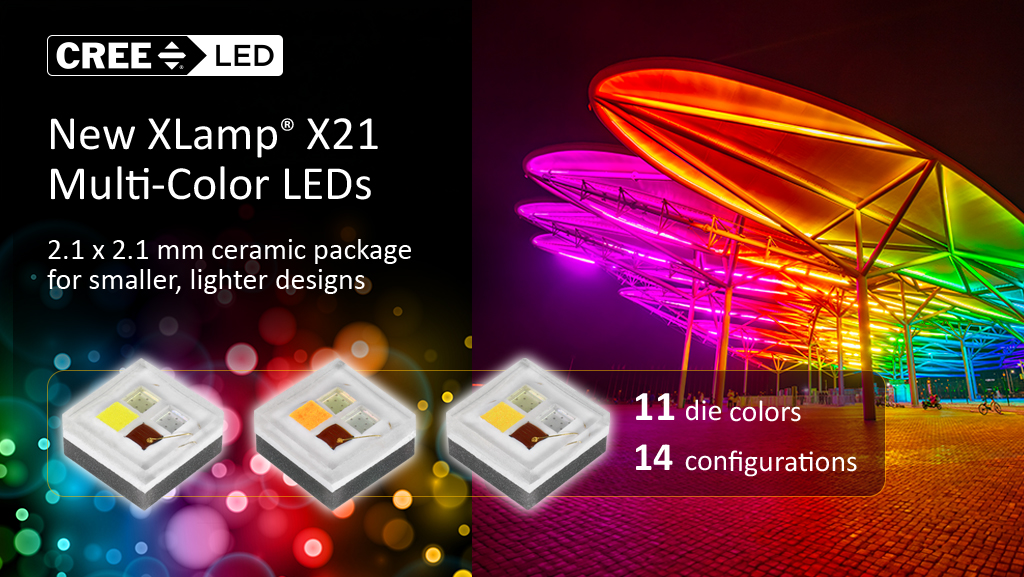
XLamp® X21 Multi-Color LEDs: A New Platform for Smaller, Lighter and More Impactful Lighting Designs
XLamp X21 Multi-Color LEDs are a new 4-color LED platform that combines an ultra-compact footprint, exceptional optical performance and extensive color flexibility to help lighting manufacturers create smaller, lighter and more impactful lighting products.
Leveraging Cree LED’s latest multi-color LED technology, XLamp X21 Multi-Color LEDs feature four different colors of LED die placed close together in a compact 2.1 x 2.1 mm ceramic package, the smallest high-power multi-color LED available.
Applications for X21 Multi-Color LEDs
The smaller optical source enables lighting manufacturers to reduce luminaire size and weight while maintaining the beam quality and visual performance demands across many applications:
- Indoor directional lighting
- Architectural lighting
- Entertainment lighting
- Automotive aftermarket lighting
- Specialty lighting
Benefits of X21 Multi-Color LEDs
- Reduce overall luminaire size
- Use smaller, lower-cost optics
- More flexibility from optical designs
- Fine-tune color for applications
- Color combinations for design goals
- Create richer saturated colors
- Balance color quality, brightness and efficiency
- One versatile LED platform for a wide range of designs
Technical Information
A New Platform Design
The new X21 package design is optimized for the smallest size possible, with a footprint that is 63% smaller than the XP-L Color. With its 8 individual pads providing full independent control of all 4 LED die inside, the X21 LED is ready for any color mixing lighting application.
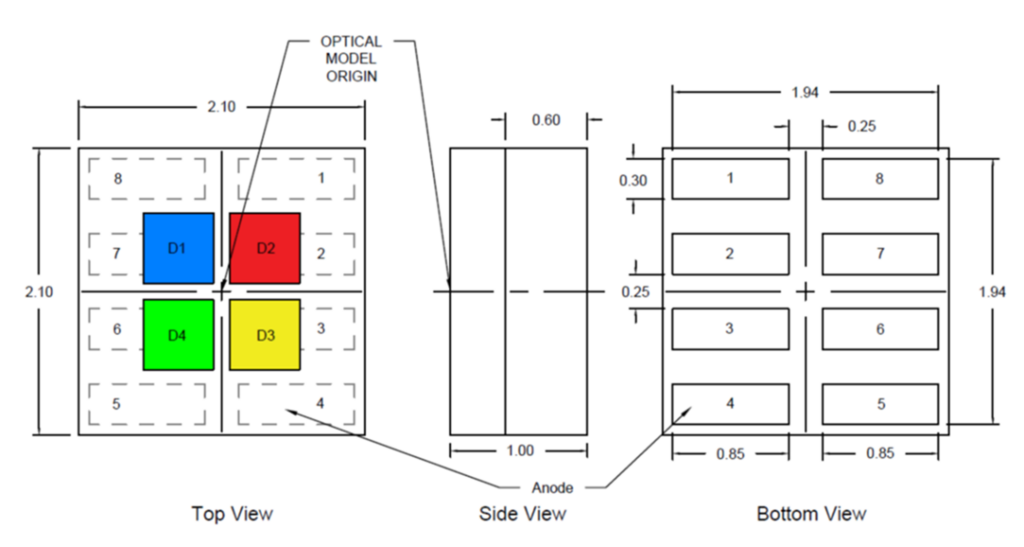
| Package Width | Package Length | Package Height |
|---|---|---|
| 2.10 mm | 2.10 mm | 1.00 mm |
| Die | Anode (+) | Cathode (-) |
|---|---|---|
| D1 (Blue) | Pad 1 | Pad 8 |
| D2 (Red) | Pad 2 | Pad 7 |
| D3 (PC/White) | Pad 3 | Pad 6 |
| D4 (Green) | Pad 4 | Pad 5 |
Optical Performance
Designed with an optimized optical profile, the X21’s compact source size also enables smaller, lighter and lower-cost secondary optics while achieving intense, tightly controlled beams. Cree LED tested the optical performance of two color-mixing optics from LEDiL, paired with different Cree LED multi-color LEDs. The table below shows the details of the test setup.
X21 Optical Performance Test Setup
| Optic Name | Height | Diameter | Area | Relative Area |
|---|---|---|---|---|
| Gabriella-45-S | 30.4 mm | 45 mm | 1590 mm² | 100% |
| Gabriella-MIDI-S | 24 mm | 38 mm | 1134 mm² | 71% |
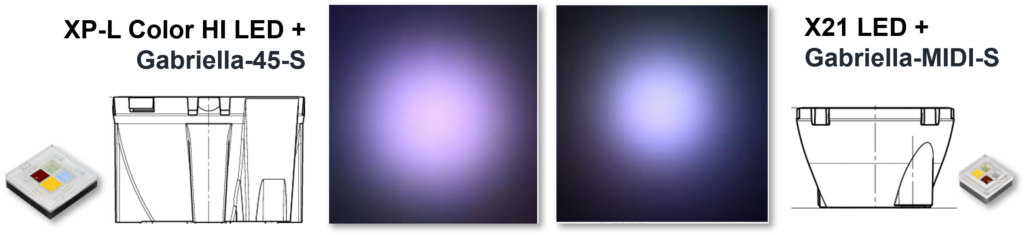
| Optic Name | LED Tested | Beam Angle | Peak Intensity |
|---|---|---|---|
| Gabriella-45-S | XP-L Color HI | 12° | 20.5 cd/lm |
| Gabriella-MIDI-S | X21 Color | 11° | 22.9 cd/lm |
This optic testing shows that relative to the larger XLamp XP-L Color LED paired with a 45 mm color-mixing optic, the new X21 LED with a 29% smaller 38 mm color-mixing optic, delivers improved optical performance, including a tighter beam angle and higher peak intensity.
Flexible Color Combinations
XLamp X21 Multi-Color LEDs offer the broadest range of color combinations in Cree LED’s multi-color portfolio, supporting eleven different LED die colors across fourteen product configurations. This flexibility enables lighting designers to optimize color quality, visual impact and system design for a wide range of applications.
| Product | Die 1 | Die 2 | Die 3 | Die 4 | Die Configuration |
|---|---|---|---|---|---|
| X21ACL | Royal | Red | White | Green | Saturation |
| X21ACB | Blue | Red | White | Green | Saturation |
| X21APA | Royal | Red | PC Amber | Green | Saturation |
| X21ABA | Blue | Red | PC Amber | Green | Saturation |
| X21APL | Royal | Red | PC Lime | Green | Saturation |
| X21ABL | Blue | Red | PC Lime | Green | Saturation |
| Available Die Color | Color Details | Typical Flux @ 175 mA, Tj = 25°C |
|---|---|---|
| Red | DWL 620-630 nm | 30 lm |
| Green | DWL 520-535 nm | 55 lm |
| Blue | DWL 465-480 nm | 15 lm |
| Royal | DWL 450-465 nm | 10 lm |
| White | 6500K, 70 CRI, 5-step | 60 lm |
| White | 5700K, 70 CRI, 5-step | 65 lm |
| White | 5000K, 80 CRI, 3-step | 60 lm |
| White | 4000K, 80 CRI, 3-step | 58 lm |
| White | 3000K, 80 CRI, 3-step | 55 lm |
| PC Amber | — | 35 lm |
| PC Lime | — | 65 lm |
Product Resources
X21 Multi-Color LEDs Data Sheet
Color LEDs Feature Sheet
Architectural & Entertainment Application Page